
2024-25 Departmental Results Report
Back to topAt a glance
This departmental results report details Invest in Canada’s actual accomplishments against the plans,
priorities and expected results outlined in its 2024–25 Departmental Plan.
Key priorities
Invest in Canada identified the following key priorities for 2024-25:
Alignment with Government of Canada priorities: Invest in Canada will continue to align its planned results with the Government of Canada’s strategic priorities and the objectives set forth in the Minister’s portfolio mandate, such as supporting inclusive economic recovery and advancing diversified trade and investment opportunities in EV supply chain (from Mines to Mobility), energy transition (including hydrogen, alternative fuels and other net-zero transition investments), and value-add agriculture.
Pan-Canadian focus: Invest in Canada will apply a national lens in delivering its mandate and continue to work on behalf of all Canadians and every part of the country.
Collaboration and partnerships: Invest in Canada prioritizes its relationship with all it partners, across all orders of government, that support the attraction and execution of FDI transactions. The organization is committed to being intentional in the way it supports partners, providing excellent business intelligence, sector focused reports, and transaction support through origination to closure of investment opportunities.
Highlights for Invest in Canada in 2024-25
- Total actual spending (including internal services): $32,743,554
- Total full-time equivalent staff (including internal services): 67
For complete information on Invest in Canada’s total spending and human resources, read the Spending and human resources section of its full departmental results report.
Summary of results
The following provides a summary of the results the department achieved in 2024-25 under its main areas of activity, called “core responsibilities.”
Core responsibility 1: Foreign Direct Investment Attraction
Actual spending: $25,550,394
Actual full-time equivalent staff: 57
Canada is promoted as a foreign direct investment destination
- Developed and launched the third iteration of the Your Second Home global advertising campaign in eight target markets, Japan, South Korea, the United Arab Emirates, Singapore, the United Kingdom, France, Germany, and Switzerland, with the objective of raising the awareness of Canada as the ideal business expansion destination among global business decision makers. The campaign included refreshed messaging and an optimized media mix to reach over 32 million unique business decision makers across the eight countries.
- Created and delivered unique content on priority sectors, targeted to decision makers, to increase consideration in sectors for investment in Canada. The organization leveraged promotional campaigns, digital marketing tactics, and events, maximizing the combined value of these strategies to further share this content, such as a minerals sector campaign that ran during the PDAC Convention and a Canadian energy sector campaign that ran alongside CERAWeek.
- Led high-impact and cohesive Invest in Canada presence at key industry events to raise awareness or consideration of Canada as an investment destination within priority sectors, including Hannover Messe, Farnborough International Air Show, EU Raw Materials Week, and the Canada in Asia Conference, among others.
Investors are investing or expanding in Canada through the support of Invest in Canada services
- Supported and guided global investors, including developing and delivering targeted business services and tools, leading site visits, among other services to help attract transformational investments in Canada’s priority sectors.
- Collaborated with partners across all levels of government on investment opportunities to deliver a seamless and cohesive experience for investors considering Canada as their destination of choice, including working with the Trade Commissioner Service in target markets to promote strategic opportunities for investment and attract new sources of investment.
- Facilitated the expansion and reinvestment of global companies in Canada by connecting firms with the right people and resources across departments and sectors, and also focused on building long-term relationships through ongoing investor relationship management and followup engagement to help existing projects succeed in Canada.
Partners have access to services and tools to support their investment attraction effort
- Built out and enhanced a suite of knowledge products and content to promote the competitive value of Canada as well as strategic benefits of Canada’s diverse regions, including development of value proposition for future sectors of focus and the Regional Spotlight blog series.
- Provided partners with tools, data and intelligence through InfoZone, Invest in Canada’s partner platform, to support partners in their investment attraction efforts. Content and tools were regularly updated and refreshed, informed by partner feedback and usage.
- Engaged with partners across all orders of government to encourage information exchange and alignment in support of their promotion and attraction efforts, including participation in federal/provincial/territorial meetings to understand FDI opportunities, initiatives, and challenges.
For more information on Invest in Canada’s Foreign Direct Investment Attraction read the ‘Results – what we achieved” section of its departmental results report.
Back to topFrom the Minister

The Honourable Maninder Sidhu
Minister of International Trade
Canada’s prosperity depends on our ability to attract and retain high-quality investment that drives innovation, creates jobs, and strengthens our country’s global competitiveness. As Minister of International Trade, it is with great pleasure and a deep sense of responsibility that I share the results from Invest in Canada’s efforts in 2024-25 to achieve these goals. The Invest in Canada 2024-25 Departmental Results Report reflects the investment promotion agency’s continued efforts to drive growth of foreign direct investment into Canada with its partners and stakeholders.
Since my appointment as the Minister of International Trade, I have met with the Invest in Canada’s Board of Directors as well as its leadership team and am encouraged by the organization’s commitment to supporting economic growth.
Over the past year, Invest in Canada demonstrated strong results in enhancing Canada’s investment brand abroad, deepening partnerships, and supporting global companies as they look to Canada for their investments. The organization continues to play a central role in advancing Canada’s value proposition and priorities on the global stage, working in coordination with the Trade Commissioner Service and other Canadian investment attraction entities to secure major investment wins for Canada.
Invest in Canada’s ongoing efforts to strengthen foreign direct investment flows into diverse sectors across the country through greater outreach and strong strategic relationships across all levels of government and with private sector partners will be critical as Canada looks to broaden its global trade and investment agenda. Invest in Canada’s experience as a liaison with investors and economic development partners across the country make it a strong tool in the Government’s toolbox in support of Canada’s economic future.
I look forward to working with Invest in Canada to support the Government’s priorities and expand global economic relationships and international business investments into Canada.
Back to topFrom Chair of the Board of Directors

Karl Tabbakh
Chair of the Board of Directors
Since 2018, Invest in Canada has been driving global investment into Canada. Over the last year, the organization demonstrated that it is positioned to navigate new challenges and create opportunities in a rapidly changing and complex operating environment. As Canada’s investment promotion agency, it is uniquely positioned to promote the country as a destination of choice for business expansion during a period of geopolitical uncertainty, while responding in real-time to investors and collaborating and communicating across the different levels of government.
Canada attracted a record-breaking $85.5 billion in foreign direct investment in 2024, the best year in a decade. In the face of declining global foreign direct investment and intensifying international competition, Canada’s advantages, including abundant resources, sophisticated business environment, access to talent and political stability, continue to set it apart on the world stage as a preferred global investment destination.
My colleagues on the Board of Directors and I stand behind Invest in Canada as it continues to deliver on its mandate, driving economic prosperity for the country. We know that the organization has built itself up to be a strong tool to support the Government’s priorities as it charts a way toward a new Canadian economic and security relationship with the United States and strengthens collaboration with reliable trading partners and allies around the world.
Although foreign direct investment inflows in 2024 provide a positive outlook, we remain cognizant that Canada needs to sustain its momentum and take full advantage of opportunities to maintain the country’s competitive advantage for global investments. The Board will continue to lend its support to Invest in Canada as it builds on its progress and helps the government tackle its priorities.
Back to topFrom Chief Executive Officer

Laurel Broten
Chief Executive Officer
On behalf of the organization, I am pleased to present the Invest in Canada 2024-25 Departmental Results Report.
In 2024, Canada witnessed a surge in FDI inflows with a total of 825 global companies choosing Canada, higher than the previous 5-year average. Invest in Canada is proud to have played a critical role in delivering these results for Canada by serving as a central hub for deal coordination and strategic multi-sectoral FDI planning and execution.
In a year of disruption and uncertainty, and in order to continue to drive momentum into the future, Invest in Canada remained closely connected with clients and the broader business community to understand their decision-making process in real-time to better support the development of prospective projects in Canada for the benefit of Canadians. The organization also maintained close collaboration with federal, provincial, territorial, and municipal partners across the country to ensure that information and data flowed to support pan-Canadian investment attraction efforts from coast to coast to coast. Through it all, Invest in Canada continued to showcase Canada’s enduring competitive advantages such as its abundant and natural resources, stable economy, dynamic and investor-focused business climate, and highly skilled, diverse, and well-educated workforce. All while adapting content and promotion to respond to ongoing shifts in the global trade and investment landscape.
Over the last year, the organization remained resilient in the face of geopolitical uncertainty, adjusting strategies and making modifications to our proven approaches to ensure that we were elevating our partners as well as meeting our client needs and expectations while fully aligned with the Government of Canada’s priorities.
I am proud of the work and commitment of Invest in Canada’s employees and leadership team as we continue to carry out the organization’s mandate. We remain the country’s leading source for information on foreign direct investment and will use this platform to highlight Canada’s reputation as a global investment destination. We are proud of the positive impact and outcomes we have been able to drive for Canada and Canadians, and I look forward to continuing to do so in the years ahead.
Back to topResults – What we achieved
Core responsibilities and internal services
Core responsibility 1: Foreign Direct Investment Attraction
In this section
- Description
- Quality of life impacts
- Progress on results
- Details on results
- Resources required to achieve results
- Related government priorities
- Program inventory
Description
Invest in Canada’s mandate is to attract, facilitate and coordinate foreign direct investment (FDI) across government entities, the private sector, and other stakeholders. Invest in Canada’s core responsibility is to lead the Government of Canada’s FDI attraction efforts by making Canada top-of mind for foreign investors and providing services in support of investor decisions to expand into Canada. In doing so, Invest in Canada’s efforts will support economic prosperity and stimulate sustainable innovation in Canada.
Quality of life impacts
Invest in Canada’s core responsibility of leading the Government of Canada’s foreign direct investment attraction efforts contributes to the Quality of Life Framework for Canada domains Prosperity and Environment and, more specifically, the indicators related to firm dynamism, employment and greenhouse gas emissions, through the activities carried out under this core responsibility.
Progress on results
This section details the department’s performance against its targets for each departmental result under
Core responsibility 1: Foreign Direct Investment Attraction
Table 1: Canada is promoted as a foreign direct investment destination
Table 1 shows the target, the date to achieve the target and the actual result for each indicator under Canada is promoted as a foreign direct investment destination in the last three fiscal years.
| Departmental Result Indicators | Target | Date to achieve target | Actual Results |
|---|---|---|---|
| Number of target audience individuals exposed to Invest in Canada’s promotional activities (content and events combined) | 1,000,000 | March 31, 2025 | 2022–23: 2,100,000 2023–24: 4,389,000 2024-25: 3,800,000 |
| Number of unique reach of promotional campaigns | 20,000,000 | March 31, 2025 | 2022–23: 33,200,000 2023–24: 33,900,000 2024–25: 32,500,000 |
| Net Promoter Score | 01 | March 31, 2025 | 2022–23: -0.6 2023-24: 12.96 2024–25: 0.8 |
Table 2: Investors are investing or expanding in Canada through the support of Invest in Canada services
Table 2 shows the target, the date to achieve the target and actual result for each indicator under Investors are investing or expanding in Canada through the support of Invest in Canada services in the last three fiscal years.
| Departmental Result Indicators | Target | Date to achieve target | Actual Results |
|---|---|---|---|
| Number of new investments or expansions supported by Invest in Canada | 25 | March 31, 2025 | 2022–23: 27 2023–24: 30 2024–25: 27 |
| Number of investors receiving Invest in Canada services | 125 | March 31, 2025 | 2022–23: 148 2023–24: 129 2024–25: 238 |
Table 3: Partners have access to services and tools to support their investment attraction efforts
Table 3 shows the target, the date to achieve the target and actual result for each indicator under Partners have access to services and tools to support their investment attraction effort in the last three fiscal years.
| Departmental Result Indicators | Target | Date to achieve target | Actual Results |
|---|---|---|---|
| Number of products (Sector Fact Sheet, Reports, Data sets, etc.) developed and shared with partners | 320 | March 31, 2025 | 2022–23: 352 2023–24: 661 2024–25: 639 |
| Number of Federal, Provincial and City partners accessing data and information on the Invest in Canada InfoZone partner portal to support investment promotion activities |
570 | March 31, 2025 | 2022–23: 614 2023–24: 753 2024–25: 1,157 |
The Results section of the Infographic for Invest in Canada on GC Infobase page provides additional information on results and performance related to its program inventory.
Details on results
The following section describes the results for Foreign Direct Investment Attraction in 2024–25 compared with the planned results set out in Invest in Canada’s departmental plan for the year.
Canada is promoted as a foreign direct investment destination
Results achieved
- Developed and launched the third iteration of the Your Second Home global advertising campaign in eight target markets, Japan, South Korea, the United Arab Emirates, Singapore, the United Kingdom, France, Germany, and Switzerland, with the objective of raising the awareness of Canada as the ideal business expansion destination among global business decision makers. The campaign included refreshed messaging and an optimized media mix to reach over 32 million unique business decision makers across the eight countries.
- Created and delivered unique content on priority sectors, targeted to decision makers, to increase consideration in sectors for investment in Canada. The organization leveraged promotional campaigns, digital marketing tactics, and events, maximizing the combined value of these strategies to further share this content, such as a minerals sector campaign that ran during the PDAC Convention and a Canadian energy sector campaign that ran alongside CERAWeek.
- Led high-impact and cohesive Invest in Canada presence at key industry events to raise awareness or consideration of Canada as an investment destination within priority sectors, including Hannover Messe, Farnborough International Air Show, EU Raw Materials Week, and the Canada in Asia Conference, among others.
Investors are investing or expanding in Canada through the support of Invest in Canada services
Results achieved
- Supported and guided global investors, including developing and delivering targeted business services and tools, leading site visits, among other services to help attract transformational investments in Canada’s priority sectors.
- Collaborated with partners across all levels of government on investment opportunities to deliver a seamless and cohesive experience for investors considering Canada as their destination of choice, including working with the Trade Commissioner Service in target markets to promote strategic opportunities for investment and attract new sources of investment.
- Facilitated the expansion and reinvestment of global companies in Canada by connecting firms with the right people and resources across departments and sectors, and also focused on building long-term relationships through ongoing investor relationship management and followup engagement to help existing projects succeed in Canada.
Partners have access to services and tools to support their investment attraction effort
Results achieved
- Built out and enhanced a suite of knowledge products and content to promote the competitive value of Canada as well as strategic benefits of Canada’s diverse regions, including development of value proposition for future sectors of focus and the Regional Spotlight blog series.
- Provided partners with tools, data and intelligence through InfoZone, Invest in Canada’s partner platform, to support partners in their investment attraction efforts. Content and tools were regularly updated and refreshed, informed by partner feedback and usage.
- Engaged with partners across all orders of government to encourage information exchange and alignment in support of their promotion and attraction efforts, including participation in federal/provincial/territorial meetings to understand FDI opportunities, initiatives, and challenges.
Resources required to achieve results
Table 4: Snapshot of resources required for Foreign Direct Investment Attraction
Table 4 provides a summary of the planned and actual spending and full-time equivalents required to achieve results
| Resource | Planned | Actual |
|---|---|---|
| Spending | $26,474,845 | $25,550,394 |
| Full-time equivalents | 57 | 57 |
The Finances section of the Infographic for Invest in Canada on GC Infobase page and the People section of the Infographic for Invest in Canada on GC Infobase page provide complete financial and human resources information related to its program inventory.
Related government-wide priorities
This section highlights government priorities that are being addressed through this core responsibility.
Gender-based analysis plus
Invest in Canada is committed to ensuring that gender-based analysis plus (GBA Plus) is considered to ensure inclusive outcomes for Canadians. An important part of Canada’s value proposition includes its diversity advantage. Through Invest in Canada’s integrated advertising campaigns and content marketing, Invest in Canada highlights Canada’s value proposition as a highly educated and diverse workforce.
In 2023-24, Invest in Canada gathered data and research on the impact of foreign direct investment in Canada, including the role of FDI on diversity to better understand the impact of investments on diverse populations. This data continues to be relevant as the organization explores a structured approach for defining, collecting and tracking data to provide long-term visibility and transparency for social and economic dimensions of the impacts of foreign direct investment.
Invest in Canada continues to monitor the post-implementation results of its pay equity exercise which was carried out in 2023. The organization submitted an annual report as required by the Pay Equity Commissioner which confirmed that there were no compensation adjustments needed for female dominated job classes
United Nations 2030 Agenda for Sustainable Development and the Sustainable Development Goals
Invest in Canada continues to align with the Government of Canada’s commitment to achieving the goals identified in the Federal Implementation Plan for the 2030 Agenda for Sustainable Development and the UN Sustainable Development Goals. Invest in Canada focused on promoting Canada’s strengths and capacity to support the clean energy transition and continues to play a role in supporting the electric vehicle battery supply chain.
More information on Invest in Canada’s contributions to Canada’s Federal Implementation Plan on the 2030 Agenda and the Federal Sustainable Development Strategy can be found in our Departmental Sustainable Development Strategy.
Program inventory
Foreign Direct Investment Attraction is supported by the following programs:
- Marketing
- Investor Services
- Data Partnerships and Pan-Canadian Collaboration
Additional information related to the program inventory for Foreign Direct Investment Attraction is available on the Results page on GC InfoBase.
Internal services
In this section
- Description
- Progress on results
- Resources required to achieve results
- Contracts awarded to Indigenous business
Description
Internal services refer to the activities and resources that support a department in its work to meet its corporate obligations and deliver its programs. The 10 categories of internal services are:
- Management and Oversight Services
- Communications Services
- Legal Services
- Human Resources Management
- Financial Management
- Information Management
- Information Technology
- Real Property
- Materiel
- Acquisitions
Progress on results
This section presents details on how the department performed to achieve results and meet targets for internal services.
In 2024-2025, Invest in Canada successfully implemented all commitments made in year two of the organization’s three-year Accessibility Plan. As captured in the 2024 Progress Report, these commitments included an audit of several policies and software, accessible documentation training, an all-staff meeting dedicated to International Day for Persons with Disabilities and the modernizing of Invest in Canada’s accommodations and IT equipment to ensure use of modern, efficient and secure work tools.
Invest in Canada successfully implemented commitments in the first year of the organization’s Diversity, Equity and Inclusion (DEI) Strategy and Action Plan. This included the implementation of an annual internal equity review on compensation, publishing our Pay Equity Plan and the launch of communication campaigns for important or commemorative days. The organization set up the DEI Committee to support the implementation of the commitments, leveraging their lived experience to ensure our HR initiatives reflect the needs of employees.
Resources required to achieve results
Table 5: Resources required to achieve results for internal services this year
Table 5 provides a summary of the planned and actual spending and full-time equivalents required to achieve results.
| Resource | Planned | Actual |
|---|---|---|
| Spending | $6,600,311 | $7,193,160 |
| Full-time equivalents | 10 |
10 |
The Finances section of the Infographic for Invest in Canada on GC Infobase and the People section of the Infographic for Invest in Canada on GC Infobase provide complete financial and human resources information related to its program inventory.
Contracts awarded to Indigenous businesses
Invest in Canada is a Phase 3 department and is aiming to achieve the minimum 5% target by the end of 2024–25.
Over the 2023-24 fiscal year, Invest in Canada ensured the alignment of internal policies and processes to support its achievement of the Mandatory Procedures for Contracts Awarded to Indigenous Businesses. The importance of this commitment was communicated to employees to encourage managers to allocate procurement budgets toward Indigenous businesses. These measures have been successful as Invest in Canada achieved a 4.98% Indigenous procurement target in 2023-2024.
To facilitate the achievement of the target by 2024-25, Invest in Canada has developed its 2024-25 and 2025-26 procurement plan for the Mandatory Minimum Five Percent Indigenous Procurement Target. The plan identifies the potential areas under each program where there are opportunities for Indigenous businesses to contribute to and support Invest in Canada’s services over the upcoming years.
Invest in Canada will continue to build on information training sessions led by Indigenous Services Canada and the Canada School of Public Service to ensure that its procurement professionals have access to appropriate training.
Invest in Canada results for 2024-25:
Table 6: Total value of contracts awarded to Indigenous businessesFootnote 11
As shown in Table 6, Invest in Canada awarded 16.62% of the total value of all contracts to Indigenous businesses for the fiscal year.
Table 6 provides a summary of the planned and actual spending and full-time equivalents (FTEs) required to achieve results.
| Contracting performance indicators | 2024-25 Results |
|---|---|
| Total value of contracts awarded to Indigenous businesses Footnote 22 (A) | $748,044 |
| Total value of contracts awarded to Indigenous and non‑Indigenous businesses³ (B) | $22,200,000 |
| Value of exceptions approved by deputy head (C) | $17,700,000 |
| Proportion of contracts awarded to Indigenous businesses [A / (B−C) × 100] | 16.62% |
- Footnote 1
-
Return to footnote 1 referrer “Contract” is a binding agreement for the procurement of a good, service, or construction and does not include real property leases. It includes contract amendments and contracts entered into by means of acquisition cards of more than $10,000.00.
- Footnote 2
-
Return to footnote 2 referrer For the purposes of the minimum 5% target, the data in this table reflects how Indigenous Services Canada (ISC) defines “Indigenous business” as either:
- owned and operated by Elders, band and tribal councils
- registered in the Indigenous Business Directory
- registered on a modern treaty beneficiary business list.
Invest in Canada’s mandate to promote foreign direct investment into Canada means that its marketing and branding efforts are largely international focused. A significant proportion of Invest in Canada’s budget is allocated to its global promotion efforts, which are facilitated by an agency of record through statements of work/contracts with international suppliers, the agency of record’s international affiliates or for services or products in international markets. Global campaigns in targeted international markets make up approximately 75% of total contracts that are proactively disclosed by Invest in Canada. Given the relative share of international contracts, Invest in Canada has in place an exception to exclude the value of international-focused contracts from the calculation of the mandatory minimum target.
Considering the total dollar value of all contracts to be awarded by Invest in Canada (minus Deputy Head approved exceptions), the organization awarded 16.62% of the total value of contracts to Indigenous businesses.
In its 2025–26 Departmental Plan, Invest in Canada estimated that it would award 12.4% of the total value of its contracts to Indigenous businesses by the end of 2024–25.
Back to topSpending and human resources
In this section
Spending
This section presents an overview of the department's actual and planned expenditures from 2022–23 to 2027–28.
Refocusing Government Spending
In Budget 2023, the government committed to reducing spending by $14.1 billion over five years, starting in 2023–24, and by $4.1 billion annually after that.
As part of meeting this commitment, Invest in Canada identified the following spending reductions.
- 2024-25: $908,000
- 2025-26: $1,228,000
- 2026-27 and after: $1,666,000
During 2024-25, Invest in Canada worked to realize these reductions through the following measures:
- Identifying efficiencies in professional services and travel expenses
- Realigning promotion expenses
- Further refining and aligning events to priority sectors
- Creating efficiencies in the use media services and data subscriptions
Budgetary performance summary
Table 7: Actual three-year spending on core responsibilities and internal services (dollars)
Table 7 shows the money that Invest in Canada spent in each of the past three years on its core
responsibilities and on internal services.
| Core responsibilities and internal services | 2024–25 Main Estimates | 2024–25 total authorities available for use | Actual spending over three years (authorities used) |
|---|---|---|---|
| Foreign Direct Investment Attraction | $26,474,845 | $27,661,225 |
|
| Subtotal | $26,474,845 | $27,661,225 | $25,550,394 |
| Internal services | $6,600,311 | $6,600,311 |
|
| Total | $33,075,156 | $34,261,536 |
|
Analysis of the past three years of spending
Invest in Canada was formally established on March 12, 2018. Spending from 2024-25 reflects funding for Invest in Canada at a steady state, including the government's actions to refocus spending.
The Finances section of the Infographic for Invest in Canada on GC Infobase offers more financial information from previous years.
Table 8: Planned three-year spending on core responsibilities and internal services (dollars)
Table 8 shows Invest in Canada’s planned spending for each of the next three years on its core
responsibilities and on internal services.
| Core responsibilities and internal services | 2025–26 planned spending | 2026–27 planned spending | 2027–28 planned spending |
|---|---|---|---|
| Foreign Direct Investment Attraction | $26,218,845 | $25,868,445 | $25,883,174 |
| Subtotal | $26,218,845 | $25,868,445 | $25,883,174 |
| Internal services | $6,536,311 | $6,448,711 | $6,452,382 |
| Total | $32,755,156 | $32,317,156 | $32,335,556 |
Analysis of the next three years of spending
After six years of operation, Invest in Canada has established internal planning and budgeting processes that ensure that actual spending and initiatives in support of the core responsibility are executed in line with the planned spending and budgetary spending indicated in the Main Estimates.
The Finances section of the Infographic for Invest in Canada on GC Infobase offers more detailed financial information related to future years.
Table 9: Budgetary actual gross spending summary (dollars)
Table 9 reconciles gross planned spending with net spending for 2024–25.
| Core responsibilities and internal services | 2024–25 actual gross spending | 2024–25 actual revenues netted against expenditures | 2024–25 actual net spending (authorities used) |
|---|---|---|---|
| Foreign Direct Investment Attraction | $25,550,394 | $0 | $25,550,394 |
| Subtotal | $25,550,394 | $0 | $25,550,394 |
| Internal services | $7,193,160 | $0 | $7,193,160 |
| Total | $32,743,554 | $0 | $32,743,554 |
Analysis of budgetary actual gross and net planned spending summary
Invest in Canada is not a revenue generating department, as such actual gross spending equals actual net spend (authorities used). Information on the alignment of Invest in Canada’s spending with Government of Canada’s spending and activities is available on GC InfoBase.
The Finances section of the Infographic for Invest in Canada on GC Infobase offers information on the
alignment of Invest in Canada’s spending with Government of Canada’s spending and activities.
Funding
This section provides an overview of the department's voted and statutory funding for its core responsibilities and for internal services. Consult the Government of Canada budgets and expenditures for further information on funding authorities.
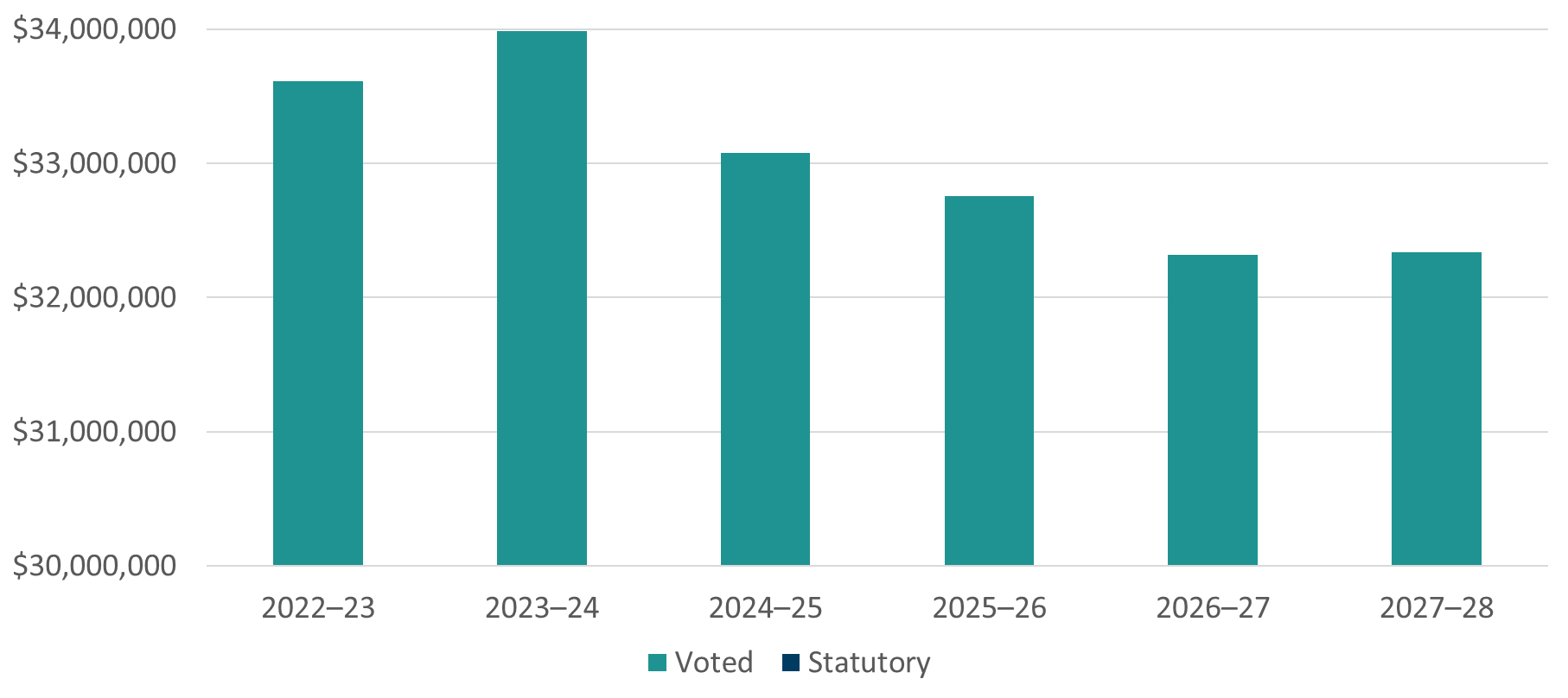
Graph 1: Approved funding (statutory and voted) over a six-year period
Graph 1 summarizes the department's approved voted and statutory funding from 2022-23 to 2027-28.
Text version of graph 1
Graph1 includes the following information in a bar graph:
| Fiscal Year | Statutory | Voted | Total |
|---|---|---|---|
| 2022-23 | $0 | $33,611,556 | $33,611,556 |
| 2023-24 | $0 | $33,986,146 | $33,986,146 |
| 2024-25 | $0 | $33,075,156 | $33,075,156 |
| 2025-26 | $0 | $32,755,156 | $32,755,156 |
| 2026-27 | $0 | $32,317,156 | $32,317,156 |
| 2027-28 | $0 | $32,335,556 | $32,335,556 |
Analysis of statutory and voted funding over a six-year period
Invest in Canada’s funding profile has matched the maturation of the organization and has reached an operational steady state. Invest in Canada is responsible for all employee benefits and pension contributions annually.
Consult the Public Accounts of Canada for further information on Invest in Canada’s departmental voted and statutory expenditures.
Financial statement highlights
Invest in Canada’s Financial Statements (Unaudited) for the Year Ended March 31, 2025.
Table 10: Condensed Statement of Operations (unaudited or audited) for the year ended March 31, 2025
(dollars)
Table 10 summarizes the expenses and revenues for 2024–25 which net to the cost of operations before government funding and transfers.
| Financial information | 2024–25 actual results |
2024–25 planned results |
Difference (actual results minus planned) |
|---|---|---|---|
| Total expenses | $33,541,347 | $33,075,156 | $466,191 |
| Total revenues | $0 | $0 | $0 |
| Net cost of operations before government funding and transfers | $33,541,347 | $33,075,156 | $466,191 |
Analysis of expenses and revenues for 2024-25
The variance is mainly due to higher than anticipated personnel costs.
The 2024–25 planned results information is provided in Invest in Canada’s Future-Oriented Statement of Operations and Notes 2024–25.
Table 11: Condensed Statement of Operations (unaudited or audited) for 2023-24 and 2024-25 (dollars)
Table 11 summarizes actual expenses and revenues and shows the net cost of operations before government funding and transfers.
| Financial information | 2024–25 actual results | 2023–24 actual results | Difference (2024-25 minus 2023-24) |
|---|---|---|---|
| Total expenses | $33,541,347 | $34,298,271 | ($756,924) |
| Total revenues | $0 | $0 | $0 |
| Net cost of operations before government funding and transfers | $33,541,347 | $34,298,271 | ($756,924) |
Analysis of differences in expenses and revenues between 2023-24 and 2024-25
The variance is primarily attributable to lower-than-anticipated costs associated with global advertising campaign optimization and increased efficiency in content marketing production. Additionally, travel and professional services costs were reduced in alignment with the government-wide refocusing spending initiative.
Table 12: Condensed Statement of Financial Position (unaudited or audited) as at March 31, 2025 (dollars)
Table 12 provides a brief snapshot of the amounts the department owes or must spend (liabilities) and its available resources (assets), which helps to indicate its ability to carry out programs and services.
| Financial information | Actual fiscal year (2024–25) | Previous fiscal year (2023-24) | Difference (2024–25 minus 2023–24) |
|---|---|---|---|
| Total net liabilities | $3,471,150 | $5,950,456 | ($2,479,306) |
| Total net financial assets | $3,809,946 | $5,879,480 | $2,069,534 |
| Departmental net debt | $338,796 | $70,976 | $267,820 |
| Total non-financial assets | $1,354,670 | $2,133,763 | ($779,093) |
| Departmental net financial position | $1,693,466 | $2,062,787 | ($369,321) |
Analysis of department’s liabilities and assets since last fiscal year
The variance in total net liabilities between 2024-25 and 2023-24 fiscal year end relates to timing for invoices received around the 2023-24 fiscal year end. The variance in total net financial assets between 2023-24 and 2024-25 is in relation to the timing of the annual HST receivable.
Human resources
This section presents an overview of the department’s actual and planned human resources from 2022–23 to 2027–28.
Table 13: Actual human resources for core responsibilities and internal services
Table 13 shows a summary in full-time equivalents of human resources for Investment in Canada’s core responsibilities and for its internal services for the previous three fiscal years.
| Core responsibilities and internal services | 2022–23 actual full-time equivalents | 2023–24 actual full-time equivalents | 2024–25 actual full-time equivalents |
|---|---|---|---|
| Foreign Direct Investment Attraction | 57 | 57 | 57 |
| Subtotal | 57 | 57 | 57 |
| Internal services | 10 | 10 | 10 |
| Total | 67 | 67 | 67 |
Analysis of human resources over the last three years
Invest in Canada was formally established on March 12, 2018. The FTEs identified in the table above reflect Invest in Canada at a fully operational and steady state.
Table 14: Human resources planning summary for core responsibilities and internal services
Table 14 shows the planned full-time equivalents for each of Invest in Canada’s core responsibilities and for its internal services for the next three years. Human resources for the current fiscal year are forecast based on year to date.
| Core responsibilities and internal services | 2025–26 planned full-time equivalents | 2026–27 planned full-time equivalents | 2027–28 planned full-time equivalents |
|---|---|---|---|
| Foreign Direct Investment Attraction | 57 | 57 | 57 |
| Subtotal | 57 | 57 | 57 |
| Internal services | 10 | 10 | 10 |
| Total | 67 | 67 | 67 |
Analysis of human resources for the next three years
Invest in Canada was formally established on March 12, 2018. The FTEs identified in the table above reflects Invest in Canada at a fully operational and steady state.
Back to topSupplementary information tables
The following supplementary information tables are available on Invest in Canada’s website:
- Gender‑based Analysis Plus
Federal tax expenditures
The tax system can be used to achieve public policy objectives through the application of special measures such as low tax rates, exemptions, deductions, deferrals and credits. The Department of Finance Canada publishes cost estimates and projections for these measures each year in the Report on Federal Tax Expenditures. This report also provides detailed background information on tax expenditures, including descriptions, objectives, historical information and references to related federal spending programs as well as evaluations and GBA Plus of tax expenditures.
Back to topCorporate information
Departmental profile
Appropriate minister(s): The Honourable Maninder Sidhu, P.C., M.P.
Institutional head: Laurel Broten
Ministerial portfolio: International Trade
Enabling instrument(s): Invest in Canada Act
Year of incorporation / commencement: 2018
Other: Invest in Canada is headquartered in Ottawa and is a departmental corporation, overseen by a board of directors (the board) accountable to the Minister of International Trade. The board is composed of up to eleven (11) part-time directors, including a Chairperson, Vice-Chairperson, and an exofficio director, the Deputy Minister of the designated Minister. Apart from the Deputy Minister, all positions are appointed by Order-in-Council to hold office for terms not exceeding three years and are eligible for reappointment in the same or another capacity. A complete list of current board appointees is available on Invest in Canada’s website.
The board supervises and manages Invest in Canada’s business and affairs and advises the Minister and the Chief Executive Officer on matters relating to the organization’s mandate. The Chief Executive Officer is responsible for Invest in Canada’s day-to-day operation.
Invest in Canada’s enabling legislation provides the framework and powers of the organization. It also provides Invest in Canada authority over matters relating to human resources management, contracting, communications, travel and hospitality and other general administrative functions.
Invest in Canada works globally, in partnership with Global Affairs Canada and its Trade Commissioner Service, other federal departments, and provincial and municipal investment attraction offices, to promote Canada as a destination for foreign direct investment.
Departmental contact information
Mailing address: 155 Queen Street, suite 1400, Ottawa, ON, K1P 6L1
Email: CorporateServices@invcanada.ca
Website(s): www.investcanada.ca
Back to topDefinitions
appropriation (crédit)
Any authority of Parliament to pay money out of the Consolidated Revenue Fund.
budgetary expenditures (dépenses budgétaires)
Operating and capital expenditures; transfer payments to other levels of government, departments or individuals; and payments to Crown corporations.
core responsibility (responsabilité essentielle)
An enduring function or role performed by a department. The intentions of the department with respect to a core responsibility are reflected in one or more related departmental results that the department seeks to contribute to or influence.
Departmental Plan (plan ministériel)
A report on the plans and expected performance of an appropriated department over a 3-year period. Departmental Plans are usually tabled in Parliament each spring.
departmental priority (priorité)
A plan or project that a department has chosen to focus and report on during the planning period. Priorities represent the things that are most important or what must be done first to support the achievement of the desired departmental results.
departmental result (résultat ministériel)
A consequence or outcome that a department seeks to achieve. A departmental result is often outside departments’ immediate control, but it should be influenced by program-level outcomes.
departmental result indicator (indicateur de résultat ministériel)
A quantitative measure of progress on a departmental result.
departmental results framework (cadre ministériel des résultats)
A framework that connects the department’s core responsibilities to its departmental results and departmental result indicators.
Departmental Results Report (rapport sur les résultats ministériels)
A report on a department’s actual accomplishments against the plans, priorities and expected results set out in the corresponding Departmental Plan.
Full-time equivalent (équivalent temps plein)
A measure of the extent to which an employee represents a full person-year charge against a departmental budget. For a particular position, the full-time equivalent figure is the ratio of number of hours the person actually works divided by the standard number of hours set out in the person’s collective agreement.
Gender-based Analysis Plus (GBA Plus) (analyse comparative entre les sexes plus [ACS Plus])
An analytical tool used to assess how different groups of women, men and gender-diverse people experience policies, programs, and other initiatives, and support the development of responsive and inclusive programs and policies. GBA Plus is a process for understanding who is impacted by the issue or opportunity being addressed by the initiative; identifying how the initiative could be tailored to meet diverse needs of the people most impacted; and anticipating and mitigating any barriers to accessing or benefitting from the initiative. GBA Plus is an intersectional analysis that goes beyond biological (sex) and socio-cultural (gender) differences to consider other factors, such as age, disability, education, ethnicity, economic status, geography (including rurality), language, race, religion, and sexual orientation.
government-wide priorities (priorités pangouvernementales)
For the purpose of the 2024–25 Departmental Results Report, government-wide priorities are the high-level themes outlining the government’s agenda in the 202 Speech from the Throne.
horizontal initiative (initiative horizontale)
A program, project or other initiative where two or more federal departments receive funding to work collaboratively on a shared outcome usually linked to a government priority, and where the ministers involved agree to designate it as horizontal. Specific reporting requirements apply, including that the lead department must report on combined expenditures and results.
Indigenous business (entreprise autochtones)
For the purposes of a Departmental Result Report, this includes any entity that meets the Indigenous Services Canada’s criteria of being owned and operated by Elders, band and tribal councils, registered in the Indigenous Business Directory or registered on a modern treaty beneficiary business list.
non‑budgetary expenditures (dépenses non budgétaires)
Net outlays and receipts related to loans, investments and advances, which change the composition of the financial assets of the Government of Canada.
performance (rendement)
What a department did with its resources to achieve its results, how well those results compare to what the department intended to achieve, and how well lessons learned have been identified.
performance indicator (indicateur de rendement)
A qualitative or quantitative measure that assesses progress toward a departmental-level or program level result, or the expected outputs or outcomes of a program, policy or initiative.
plan (plan)
The articulation of strategic choices, which provides information on how a department intends to achieve its priorities and associated results. Generally, a plan will explain the logic behind the strategies chosen and tend to focus on actions that lead to the expected result.
planned spending (dépenses prévues)
For Departmental Plans and Departmental Results Reports, planned spending refers to the amounts presented in Main Estimates. Departments must determine their planned spending and be able to defend the financial numbers presented in their Departmental Plans and Departmental Results Reports.
program (programme)
An Individual, group, or combination of services and activities managed together within a department and focused on a specific set of outputs, outcomes or service levels.
program inventory (répertoire des programmes)
A listing that identifies all the department’s programs and the resources that contribute to delivering on the department’s core responsibilities and achieving its results.
result (résultat)
An outcome or output related to the activities of a department, policy, program or initiative.
statutory expenditures (dépenses législatives)
Spending approved through legislation passed in Parliament, other than appropriation acts. The legislation sets out the purpose and the terms and conditions of the expenditures.
target (cible)
A quantitative or qualitative, measurable goal that a department, program or initiative plans to achieve within a specified time period.
voted expenditures (dépenses votées)
Spending approved annually through an appropriation act passed in Parliament. The vote also outlines the conditions that govern the spending.